
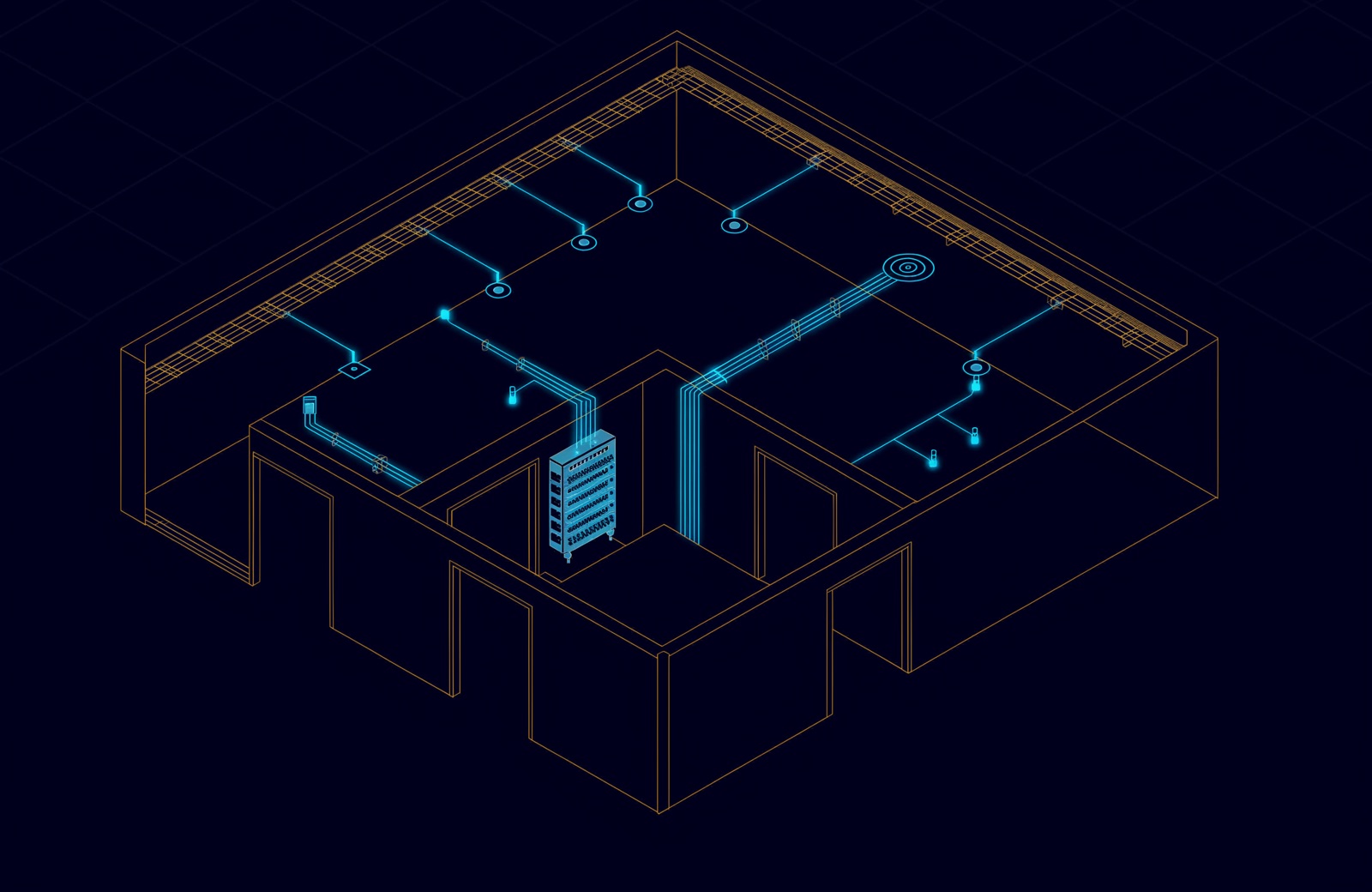
ELV stands for extra-low voltage. Electrically, it means a voltage of no more than 50 V AC or 120 V DC, the ceiling written into Abu Dhabi's wiring regulations. In UAE construction, an ELV system also means the "low current" package: structured cabling, networks and Wi-Fi, CCTV, access control, intercom, PA, IPTV, BMS and fire alarm.
The two meanings overlap but are not the same, and the difference decides who designs a system, who may install it and who signs it off.
ELV full form and meaning
The full form of ELV is extra-low voltage. The International Electrotechnical Commission defines it in its vocabulary as a voltage no higher than the touch voltage a person can be exposed to indefinitely under stated conditions (IEC 60050, IEV 195-05-24). In plain terms: low enough that contact is not expected to be dangerous in the conditions the installation was designed for.
Abu Dhabi puts numbers on it. The Department of Energy's Electricity Wiring Regulations (2020) define extra-low voltage as a voltage not exceeding 50 V AC or 120 V DC, between live conductors or between a live conductor and earth. The same document sets the normal supply in a building at 230 V single-phase or 400 V three-phase (clause 4.1.2), and calls that whole mains range low voltage, LV.
That causes most of the confusion. In the regulations, "low voltage" is the mains; on Gulf sites, "low current" or "light current" is the ELV package. A drawing marked LV and one marked ELV belong to different trades.
| Term in Abu Dhabi's regulations | AC limit (V) | DC limit (V) | Where you meet it |
|---|---|---|---|
| Extra-low voltage (ELV) | not exceeding 50 | not exceeding 120 | PoE devices; underwater lighting, which must be SELV at no more than 12 V AC or 30 V DC |
| Low voltage (LV) | below 1,000 between phases (600 to earth) | below 1,500 (900 to earth) | The 230 V single-phase and 400 V three-phase supply |
| High voltage (HV) | above LV, below 36,000 between phases (21,000 to earth) | not defined | The distribution network; called medium voltage internationally |
SELV and PELV: the two protected kinds of ELV
A voltage under 50 V is not automatically safe. What makes ELV a protection measure is how it is produced and kept apart from the mains:
- SELV (separated extra-low voltage in Abu Dhabi's regulations, safety extra-low voltage in the IEC vocabulary). The circuit is separated from earth so that a single fault cannot cause a shock. Its source is a safety isolating transformer to BS EN 61558 or a battery, and no exposed metal part is connected to earth (clauses 9.1.1 to 9.1.5). The IEC adds that the voltage cannot exceed ELV even under a single fault, including an earth fault in another circuit (IEV 195-06-28).
- PELV (protective extra-low voltage). The same separation from the source, but exposed metal parts may be connected to earth (clause 9.2.1; IEV 195-06-29).
Even inside SELV, live parts must be insulated once the operating voltage exceeds 12 V AC or 30 V DC (clause 9.1.6). A third term, FELV (functional extra-low voltage), appears in some specifications but not in Abu Dhabi's regulations; if a document relies on it, ask the electrical consultant how that circuit is protected.
Why telecoms, alarms and controls are grouped as low current
Because electrical standards long placed them in the lowest voltage band, as installations whose voltage is limited for operational reasons. The IEC's old voltage band standard, IEC 60449 (1973, since replaced by IEC 61140:2016), described Band I as covering installations where the voltage is limited for operational reasons, and gave telecommunications, signalling, bell, control and alarm installations as examples. Abu Dhabi's wiring regulations still sort circuits in a similar way:
- Category 1: circuits operating at LV, the mains (other than fire alarm and emergency lighting).
- Category 2: circuits that supply telecommunications equipment, such as telephones, intruder alarms, data transmission and call bells.
- Category 3: fire alarm and emergency lighting circuits.
Categories 2 and 3 cover much of what today's ELV package contains, but not all of it. CCTV now includes recorders and servers on 230 V, and network switches and IPTV headends sit in racks fed from the mains. Not every box in the ELV package is extra-low voltage.
ELV systems list: what a UAE package includes
The ELV package is a contract grouping, not a category in the wiring regulations; each consultant groups it in their own specification, so the boundary moves between projects. These are the systems that typically appear under ELV, low current or light current in UAE buildings. Check your own specification's divisions before you price.
| System | What it does | Typical cabling | Typical power source |
|---|---|---|---|
| Structured cabling (data and voice) | The copper and fibre that every other system rides on | Cat6 or Cat6A copper, fibre backbone | None, it is passive |
| Network switching and Wi-Fi | Connects users, devices and the internet | Cat6A to access points, fibre uplinks | Switches on mains, access points on PoE |
| IP telephony | Desk phones and call handling | Cat6 or Cat6A | Phones on PoE, call server on mains |
| CCTV | Video surveillance and recording | Cat6 or Cat6A, fibre for long runs | Cameras on PoE, recorders on mains |
| Access control | Decides who can open which door, and when | Network cable plus multicore to readers and locks | Controllers and locks on local DC supplies with batteries |
| Intercom and video door phones | Visitor calls to reception or tenants | Network cable or a two-wire bus | PoE or a local DC supply |
| Intrusion alarm | Detectors and a panel that signal a break-in | Alarm cable | Panel with a standby battery |
| PA and background music | Announcements and music | Speaker cable | Amplifiers on mains |
| IPTV or SMATV | Television distribution to rooms | Coaxial or network cable | Headend on mains |
| BMS and lighting control | Monitors and controls building plant | Control cable and the IP network | Controllers on local ELV supplies |
| Fire alarm and voice evacuation | Detects fire and tells people to leave | Fire-resistant cable in its own segregated containment | Panels on mains with standby batteries |
Other systems that often join the package: nurse call, master clock, car park guidance, gate barriers, queue and visitor management, and time attendance. On the network side, two existing articles go deeper: Cat 6A or fibre, and what UAE cabling must answer for, and campus wireless for the morning everyone arrives.
Which ELV systems need a Civil Defence approved contractor?
Fire detection and alarm, emergency voice evacuation and emergency lighting. The UAE Fire and Life Safety Code of Practice (September 2018 edition) says installation of fire detection and alarm systems "shall be carried out only by Civil Defence approved and licensed contractors", and names who may not do it: general contractors, MEP contractors, electrical contractors, BMS contractors and home automation contractors (Chapter 8, clause 6.2.1).
Voice evacuation and two-way telephone systems may only be installed by approved fire detection and alarm contractors (Chapter 7, clause 4.2.1). Emergency lighting may only be installed by Civil Defence approved and licensed contractors, and the code adds fit-out contractors to those who may not install it (Chapter 6, clause 5.2.1). Contractors qualify by passing a Civil Defence examination, and may not start on site without drawings stamped by Civil Defence (Chapter 8, clauses 6.2.3 and 6.2.4). In Abu Dhabi the civil defence authority is the Abu Dhabi Civil Defence Authority (ADCDA); confirm the current approval route with it or with your consultant before tender.
So a company that installs your cabling, CCTV and access control is not automatically allowed to install your fire alarm. If one firm quotes for the whole ELV division, ask which approved contractor delivers the fire and life safety part, and ask to see the approval.
The wiring regulations point the same way. Fire alarm and emergency lighting circuits may not share a conduit or trunking with mains or telecommunications circuits unless suitable segregation is provided (clause 7.4.17), and safety circuits that must keep working in a fire are installed in metal conduit or mineral-insulated (MICC) cable (clause 7.5.3).
How ELV devices are powered: PoE
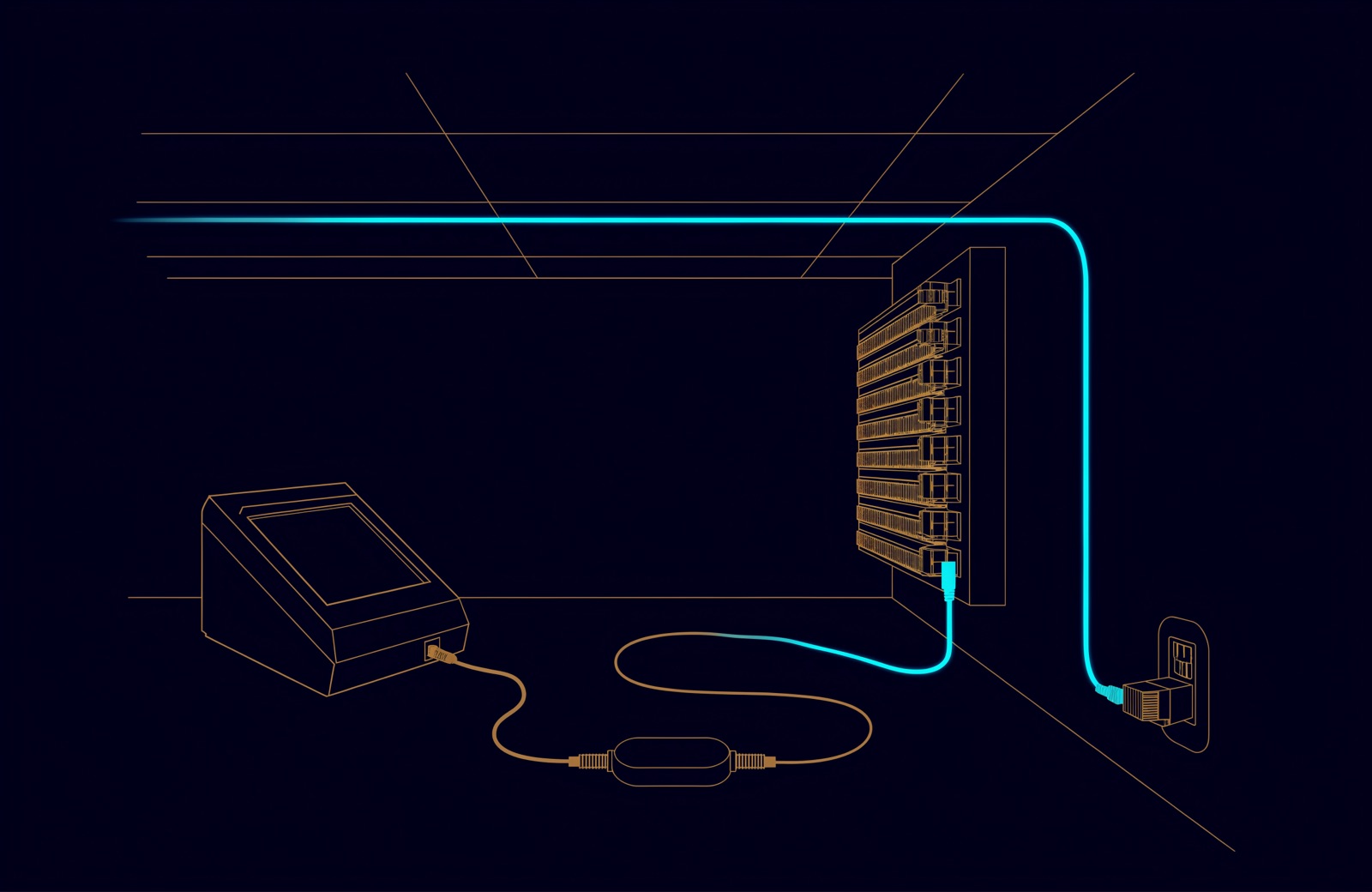
Most network-connected ELV devices now take their power from the data cable. Power over Ethernet lets a switch power cameras, access points, phones and door stations, and IEEE 802.3bt-2018 raised the power available by using all four pairs of the cable. According to the Ethernet Alliance overview of 802.3bt, the maximum voltage at the switch port is 57 V DC for every PoE type, which keeps PoE inside the 120 V DC ELV ceiling.
| PoE class | Standard and type | Power at the switch port (W) | Power at the device (W) |
|---|---|---|---|
| Class 3 | 802.3af, Type 1 | 15.4 | 13 |
| Class 4 | 802.3at, Type 2 | 30 | 25.5 |
| Class 6 | 802.3bt, Type 3 (four pairs) | 60 | 51 |
| Class 8 | 802.3bt, Type 4 (four pairs) | 90 | 71.3 |
The gap between the two power columns is the allowance for loss in the cable under worst-case conditions: the highest cable resistance the standard permits, with the device drawing its full class power. Shorter runs lose less, but a switch reserves the full port figure unless it measures what the device actually draws. A cabling decision is therefore also a power decision, and the switch PoE budget belongs in the ELV design, not in commissioning. For a camera estate, see when CCTV becomes a network problem.
The ELV room, the riser and ELV in MEP
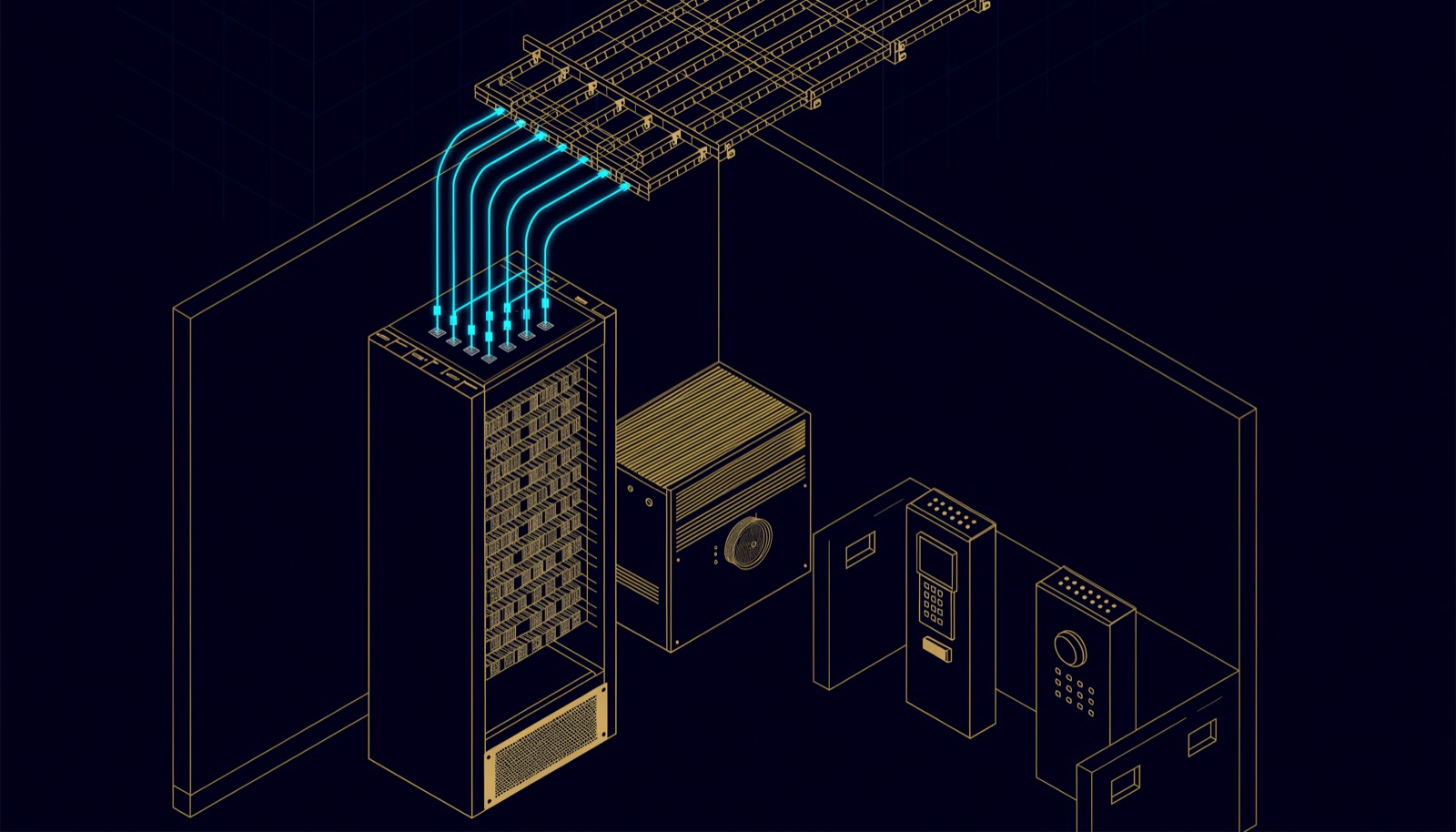
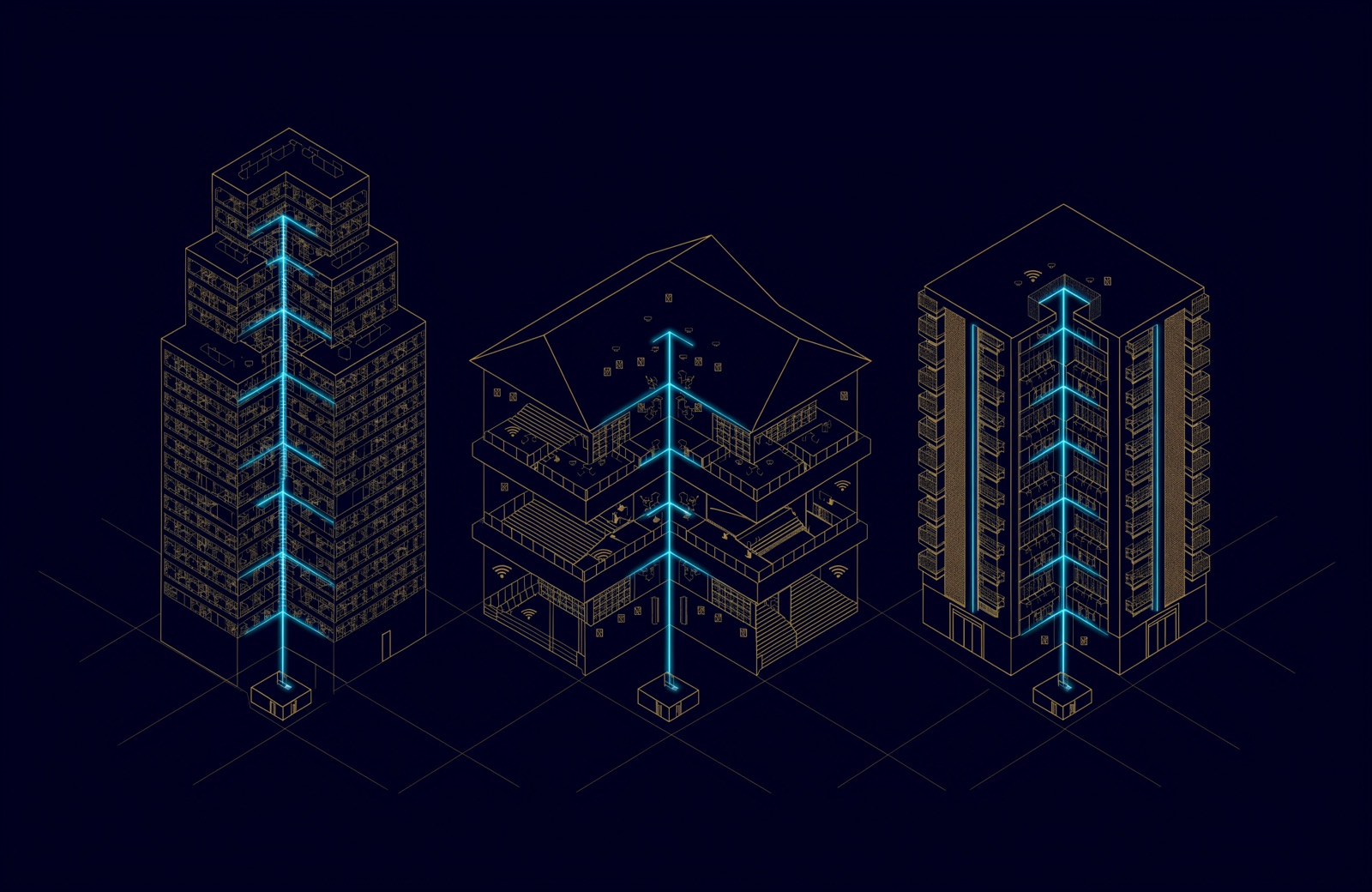
In MEP drawings, ELV normally has its own services drawings within the electrical scope, and is often let to a specialist subcontractor. Two spaces carry it. The ELV room (also called the telecom or IT room) holds the racks: patch panels, switches, recorders, headends and access control and intercom panels. The riser carries fibre and copper backbone cables between floors, and each floor's horizontal cabling fans out from it.
Abu Dhabi's wiring regulations set the containment rules that ELV shares with power:
- Where trunking or tray carries power and telecommunications together, adequate segregation must be provided (clause 7.4.16).
- Category 1 (mains) and Category 2 (telecommunications) circuits may share a conduit or trunking only if it is insulated to the Category 1 level (clause 7.4.18).
- Trunking and tray stay exposed or accessible along their whole length, so cables can be added or removed (clause 7.4.14).
- Conduit runs have at most two 90 degree bends, or three 120 degree bends, between inspection or pulling points (clause 7.4.13).
Three decisions are cheapest on paper: the size and position of the ELV room and riser, the containment routes, and power and cooling for the racks. All three are far harder to change once the ceilings are closed.
How UBM handles it
UBM designs and installs the parts of the ELV package that live on the network: structured cabling, switching and Wi-Fi, CCTV, access control and intercom. We coordinate the ELV and cabling design with the main contractor and the MEP package before first fix, and agree rack elevations, riser allocation, containment routes and power on the drawings. Devices are installed to the coordinated positions, commissioned and witnessed, and the facilities team receives the complete as-built and warranty pack on handover day, with a maintenance agreement already in place. The detail is on our network and structured cabling and CCTV and physical security pages.
Under the UAE code, fire detection and alarm, voice evacuation and emergency lighting are installed by Civil Defence approved contractors. Where a project includes them, we keep containment and riser space for their segregated routes on the same drawings, and agree the interfaces between their system and ours, such as door release on a fire alarm, with the approved contractor. To have an ELV specification or a riser layout reviewed, talk to a UBM engineer.
Questions people ask
What is the full form of ELV?
Extra-low voltage: in Abu Dhabi's wiring regulations, not exceeding 50 V AC or 120 V DC. In contracting, ELV also names the low current package of cabling, network, security and building systems.
Is ELV the same as low voltage (LV)?
No. In the regulations, LV is the mains range, below 1,000 V AC between phases, including the 230 V and 400 V supply. ELV sits beneath it. "Low current" in Gulf usage means the ELV package, not LV.
Is fire alarm an ELV system?
It is usually listed in the ELV package, but the UAE Fire and Life Safety Code of Practice allows only Civil Defence approved and licensed contractors to install fire detection and alarm, voice evacuation and emergency lighting.
Is CCTV part of ELV?
Yes, in the package sense. Electrically it is split: PoE cameras run inside the ELV limit (PoE tops out at 57 V DC), while recorders and servers run on the 230 V mains.
What is an ELV room?
The room that houses the ELV racks: patch panels, switches, recorders, headends and system panels. It connects to the riser, which carries backbone cabling to every floor. Larger buildings often have one on each floor.
Do ELV cables need to be separated from power cables?
Yes. Abu Dhabi's wiring regulations require segregation where power and telecommunications share trunking or tray, and keep fire alarm and emergency lighting circuits apart from both.
Sources
- IEC 60050 International Electrotechnical Vocabulary, IEV 195-05-24 "extra-low voltage" (IEC, 2021)
- IEV 195-06-28 "SELV system" and IEV 195-06-29 "PELV system" (IEC, 2021)
- IEC 60449:1973, Voltage bands for electrical installations of buildings (IEC, 1973; withdrawn 2016)
- IEC 61140:2016, Protection against electric shock: common aspects for installation and equipment (IEC, 2016)
- The Electricity Wiring Regulations (2020) (Department of Energy, Abu Dhabi, 2020)
- UAE Fire and Life Safety Code of Practice, September 2018 edition (UAE Civil Defence, 2018)
- Abu Dhabi Civil Defence Authority (ADCDA, 2026)
- IEEE 802.3bt-2018, Power over Ethernet over 4 pairs (IEEE, 2018; now superseded)
- Overview of 802.3bt, Power over Ethernet standard (Ethernet Alliance, 2019)
Comments
Questions and experience from readers. A person reads every comment before it appears.
No comments yet. If something here does not match what you have seen on site, say so.