
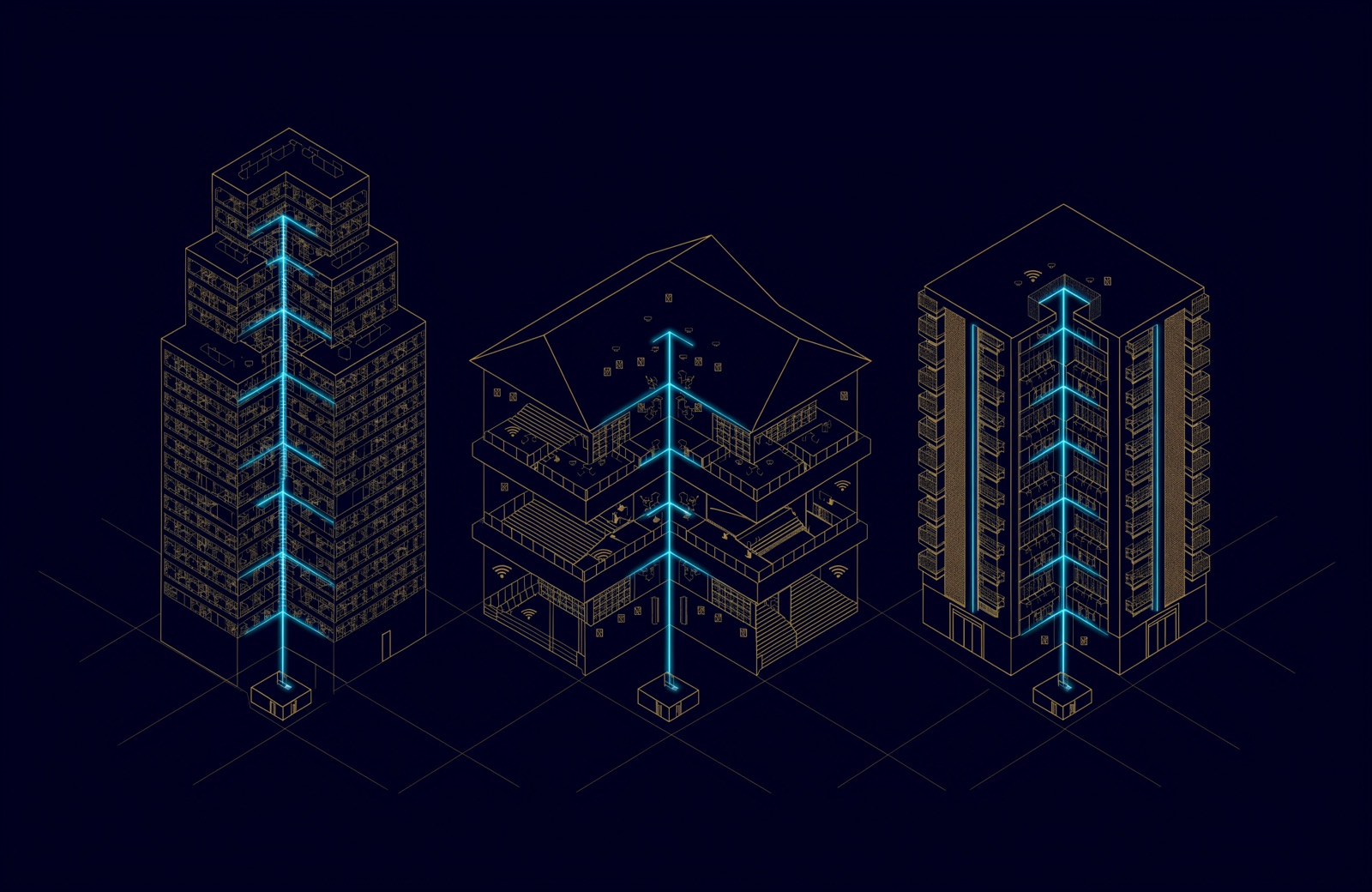
Every new office building, school and hotel in the UAE needs fire detection and alarm, operator telecom rooms and CCTV built to the national surveillance manual. In Abu Dhabi, ELV systems for schools and hotels must also include voice evacuation, a CCTV control room and access control, and hotels add Wi-Fi throughout and a TV and phone in every room.
Everything else, from IP phones to lobby music, is a design choice. Abu Dhabi comes first, then Dubai and hospitals. Documents were checked on 2 October 2026; this is a design guide, not legal advice.
ELV design by building type: the matrix
Read it one column at a time. A gold ring means a named document requires the system; a filled dot means typical but not required by any document cited here; a hollow dot means it depends on the brief. New to ELV? Start with what an ELV system is and what it covers.
| System | Office building | School | Hotel | Where the requirement comes from |
|---|---|---|---|---|
| Fire detection and alarm | Required | Required | Required | UAE Fire and Life Safety Code, Table 8.13 |
| Voice evacuation and two-way telephone | Required only in high-rise (over 23 m) | Required | Required | UAE Fire and Life Safety Code, Table 7.3 |
| Operator telecom rooms and fibre | Required (new buildings) | Required (new buildings) | Required (new buildings) | TDRA Buildings Telecommunications Network Specification Manual, clause 2.2 |
| CCTV to the surveillance manual | Required (90 days storage) | Required (90 days) | Required (180 days) | National Manual for Surveillance Systems v3.0, categories table |
| CCTV monitoring and control room | Optional | Required (except nurseries) | Required | National Manual, categories table; ADEK Safeguarding Policy, 5.1 |
| Access control | Typical | Required | Required (key-card doors) | ADEK Safeguarding Policy, 5.1; DCT Hotel Classification Manual, 1.3.13.5 |
| Network security and Wi-Fi | Typical | Required (firewalls, intrusion detection or prevention, web filtering; Wi-Fi not specified) | Required (Wi-Fi throughout) | ADEK Digital Policy, 6.1; DCT manual, 1.6.7.1 |
| Telephony | Typical | Typical | Required (a phone in every room) | DCT manual, 1.3.18.4 |
| PA, bells and announcements | Project choice | Typical | Typical | Schools: recall signal in Table 8.13; ADEK Safeguarding Policy, 5.9 |
| TV distribution (IPTV or SMATV) | Project choice | Project choice | Required (a TV in every room) | DCT manual, 1.3.19.1 (TV) and 1.3.19.2 (channel reception) |
Counted down the columns, an office building has three required systems (four if high-rise), a school seven and a hotel nine. The school and hotel columns use Abu Dhabi's sector regulators: the Department of Education and Knowledge (ADEK) for private and charter schools, and the Department of Culture and Tourism (DCT) for hotels.
Which ELV systems are required in every building?
Fire detection and alarm, operator telecom infrastructure and, for these three building types, CCTV. Three rulebooks set them, whatever the building is used for.
Fire detection and alarm. Table 8.13 of the UAE Fire and Life Safety Code of Practice (September 2018 edition) requires smoke detection and alarm "throughout the building" for business, education and hotel buildings alike. It also links the fire alarm to door release and lift recall, which is where it meets access control. Fire alarm, voice evacuation and emergency lighting are installed only by Civil Defence approved contractors, as our ELV guide explains clause by clause.
Voice evacuation. Table 7.3 requires an emergency voice evacuation or communication system and a two-way telephone system in high-rise and super high-rise buildings, malls, assembly, educational and hotel occupancies, among others. Business occupancies are not on that list, so for an office building the trigger is height:
| Fire code category (clauses 1.7.39 to 1.7.42) | Building height (m) | Voice evacuation in an office building |
|---|---|---|
| Low rise | up to 15 | Not listed in Table 7.3 |
| Mid rise | 15 to 23 | Not listed in Table 7.3 |
| High rise | 23 to 90 | Required |
| Super high rise | over 90 | Required |
Height is measured from the lowest grade or the lowest level of fire service access, excluding roof parapets.
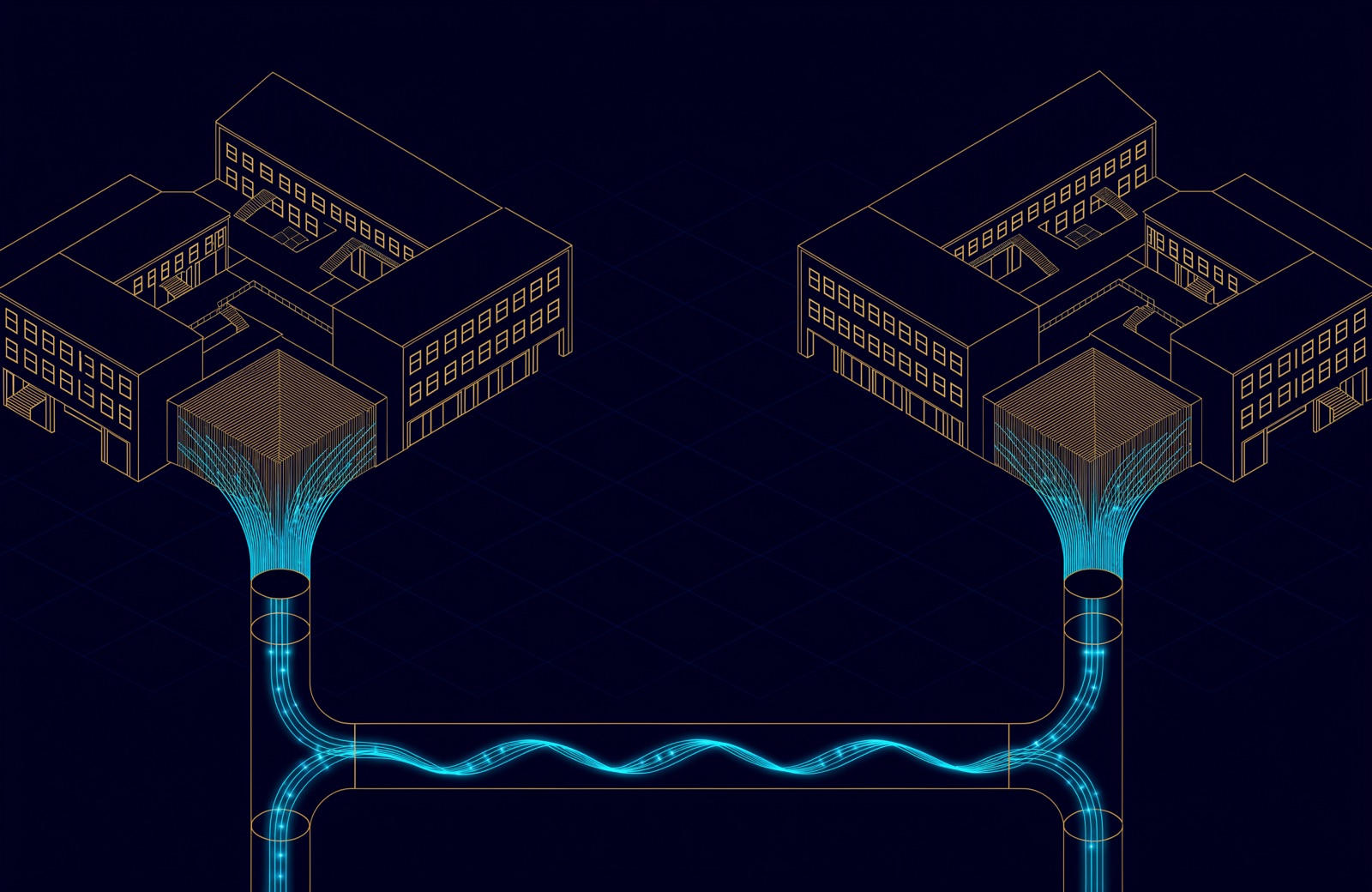
Operator telecom rooms. The TDRA's Buildings Telecommunications Network Specification Manual (V3.0, 2024) says all new buildings, and major renovations, shall have physical infrastructure that can host high-speed networks and that the operators can easily reach (clause 2.2): in practice, telecom rooms, ducts and fibre, as our article on ELV rooms, IT rooms and server rooms sets out.
CCTV. The National Manual for Surveillance Systems (version 3.0, 2026), published by Abu Dhabi's Monitoring and Control Centre (MCC), lists the categories that "shall comply", each served by an entity licensed by the concerned authorities. All three building types are listed:
| Category in the National Manual | Storage (days) | Control room | Number plate reader (ANPR) | AI video analytics |
|---|---|---|---|---|
| Residential compounds, buildings and commercial buildings (any building with residential or office units) | 90 | Optional | Mandatory | Optional |
| Educational entities | 90 | Mandatory, except nurseries | Mandatory, except nurseries | Mandatory, except nurseries |
| Hotels, hotel apartments and limited residential accommodation (Group B) | 180 | Mandatory | Mandatory | Mandatory |
ANPR becomes mandatory only where the facility has a designated parking area, and the concerned authorities may set storage periods, with 30 days as the minimum, so confirm your site's category with MCC. Our CCTV systems guide for UAE businesses turns these periods into cameras, storage and network load.
ELV systems for offices and commercial buildings
The building needs the required systems above; almost everything inside a tenant's office is a choice. The National Manual asks commercial buildings to cover their public places, on top of entrances, emergency exits, lobbies, lifts, stairs and corridors. Those cameras belong to the building; a tenant's own are a separate decision unless the tenant's activity is itself a listed category, such as a government authority or a money exchanger.
Typical in an office fit-out, and required by none of the documents here: structured cabling, Wi-Fi, IP phones, access control, a visitor intercom and meeting room AV. The real decisions are where the tenant's rack sits, how its doors release on the building's fire alarm, and whether the landlord's riser has room for its cables.
ELV systems for schools
A school in Abu Dhabi also answers to ADEK, whose policies turn several typical systems into required ones. The ADEK School Safeguarding Policy (version 1.2, January 2025, compliance from 1 February 2026) says schools "shall be equipped with integrated and fully functioning access and security systems", including CCTV (5.1).
| What a school must have | Document and clause |
|---|---|
| Access and security systems, including CCTV installed and maintained by an MCC-licensed vendor under a valid maintenance contract | ADEK Safeguarding Policy, 5.1 |
| Cameras on entrances, walkways, pick-up and drop-off areas, the exterior, learning spaces, toilet and changing room entrances and all blind spots; never inside toilets or changing rooms | ADEK Safeguarding Policy, 5.1 |
| A monitoring and control room, live view in the principal's office, and recordings kept at least 90 days or as MCC currently requires | ADEK Safeguarding Policy, 5.1 |
| A way to lock down the school, manually or automatically, and serviced alert systems for announcements and timed bells where fitted | ADEK Safeguarding Policy, 5.9 |
| Next-generation firewalls, intrusion detection or prevention, web filtering and identity-based firewalls | ADEK School Digital Policy, 6.1 |
| ANPR where the school has a designated parking area, and AI video analytics (violent behaviour and dangerous object detection in classrooms and play areas) | National Manual, categories table and Section 05, 2.2.1 |
| Fire alarm annunciator and a total evacuation switch in the principal's office, and a student recall signal distinct from the fire alarm | UAE Fire and Life Safety Code, Table 8.13 |
Two points catch projects out. ADEK's policies, including the School Building and Facilities Policy (2.8), still cite MCC's 2023 manual, which MCC's site replaced with version 3.0 of the National Manual in September 2026, so check which text your design follows. And classroom cameras plus filtering on every student device load the network: see campus wireless for the morning everyone arrives.
ELV systems for hotels
A hotel also answers to DCT's classification rules. The Abu Dhabi Hotel Classification Manual linked from DCT's licensing page (the file dates from September 2018) sets minimum mandatory criteria for every star category, from one to five, including:
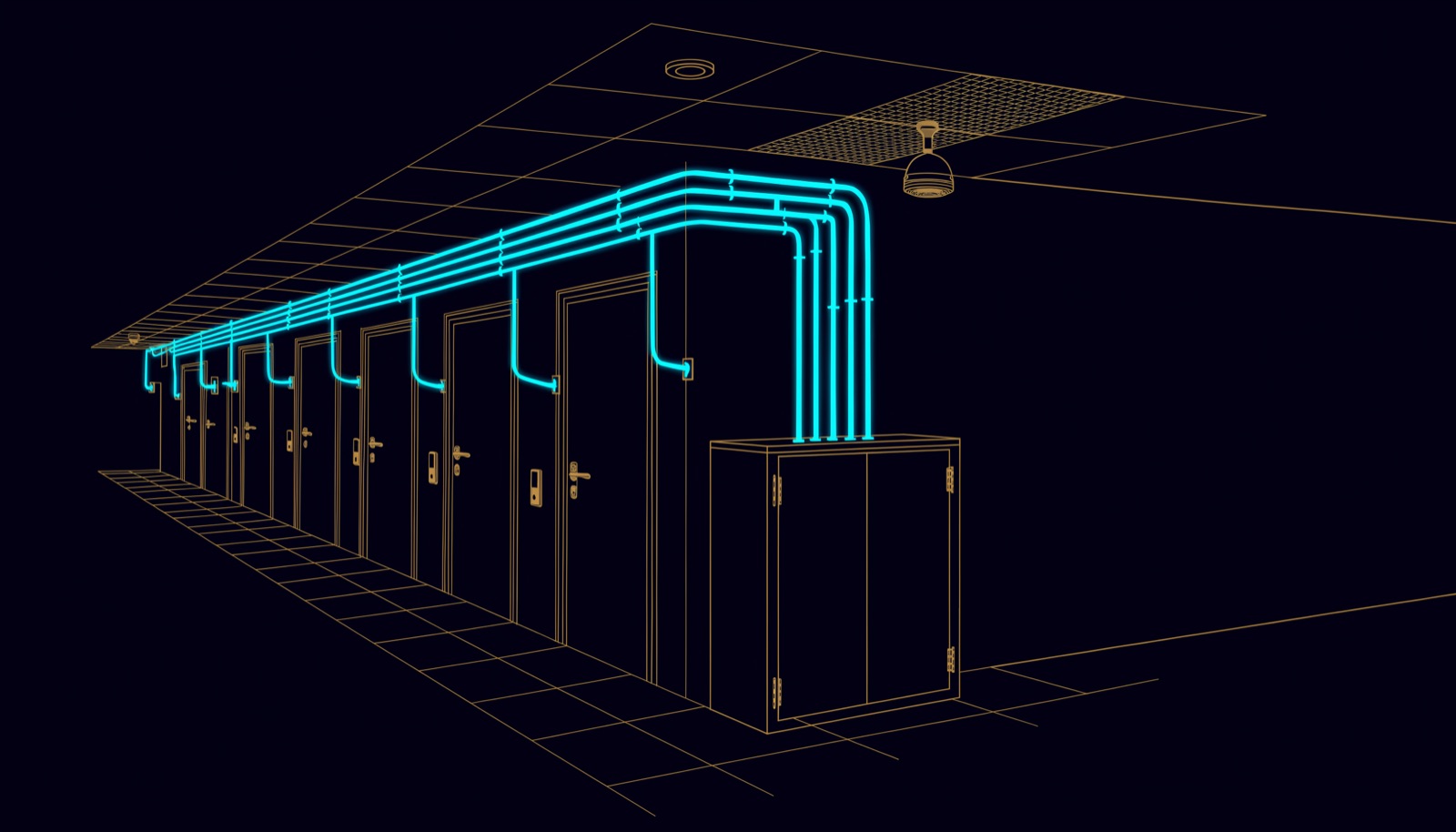
- Premises monitored 24 hours a day by security cameras, as per the emirate's regulations (1.2.1.1).
- An electronic key card door system (1.3.13.5) and emergency lighting in each bedroom (1.3.14.5).
- At least one telephone handset in the bedroom (1.3.18.4).
- A flat-screen colour television of at least 32 inches (1.3.19.1).
- Wi-Fi throughout the hotel, including outdoor areas used by guests (1.6.7.1).
Three to five star hotels also need constant mobile reception in guest areas, through a booster if required (1.6.14.1). Ask DCT whether a newer edition applies.
The National Manual puts hotels in Group B, with 180 days of storage and a mandatory control room, ANPR and AI video analytics. The fire code adds voice evacuation, two-way telephone, and an annunciator and total evacuation switch at reception. A general fire alarm does not trigger evacuation, but if it is not silenced or reset within 120 seconds, or other devices alarm in that time, the whole building evacuates (Table 8.13).
The TDRA manual also describes a "bulk service" layout, usually applied to single-tenant buildings with their own IT network such as hotels, schools and hospitals: a 42U rack in the main telecom room, and 12 fibre cores and 24 Cat6A cables to the client's IT server room within 70 m, split between Etisalat and du (clause 5.11). IPTV or SMATV, and links to the property management system, are design choices.
What changes in Dubai: SIRA's sector chapters
Dubai sites follow the Preventive Systems Manual approved by SIRA's Administrative Resolution No. 13 of 2025, whose general recording specification is at least 31 days, plus sector chapters. SIRA is also listed as a concerned authority in the 2026 National Manual, so confirm with SIRA which document your site follows. Beyond the camera lists:
| Building type (SIRA chapter) | Requirements beyond the camera list |
|---|---|
| Luxury and tourist hotels (Part Three, Chapters 1 and 2) | Electronic room entry system whose locks record at least 1,500 entries and exits, with records kept at least six months; an independent, closed surveillance room; ANPR at vehicle entrances; SIRA-approved system health monitoring |
| Schools (Chapter 8) | Cameras including inside classrooms, laboratories and the clinic; ANPR; 24-hour security guards; system health monitoring |
| Multi-storey commercial buildings (Chapter 4) | ANPR; a guard or watchman around the clock; system health monitoring |
| Multi-storey residential buildings (Chapter 4) | Access control mandatory below 50 units; optional at 50 units or more, where a guard or watchman around the clock becomes mandatory |
ELV systems in hospitals: a separate specification
Hospitals sit outside the matrix because a health regulator adds its own design rules. In Abu Dhabi, the Department of Health's Health Facility Guidelines include an "ELV and ICT systems" chapter in Part E, Engineering, which asks designers to consider a medical grade network following ISO/IEC 11801, carrying services such as voice, data, CCTV, public address, nurse call, central clock and queuing. Launching its facility design standards in 2011, the regulator (then the Health Authority Abu Dhabi) said future and refurbished facilities would need to comply to be licensed; confirm the current route with DoH.
The general rulebooks still apply, with hospital clauses: annunciators at nurse stations and an evacuation push button within 61 m of each one (Table 8.13), and a mandatory control room, ANPR and AI analytics for public and private hospitals, with 30 days of storage, under the National Manual.
How UBM handles it
UBM designs and installs the network side of the ELV package for government, education, hospitality, real estate and commercial clients: structured cabling, switching and Wi-Fi, CCTV, access control and intercom. On a new building we list the documents that apply to its type, mark every ELV system on one schedule as required or chosen, with the clause beside each required one, and agree it with the consultant before first fix. Storage is sized to the category's retention period and telecom rooms follow the TDRA layout. The detail is on our CCTV and physical security and network and structured cabling pages.
Fire alarm, voice evacuation and emergency lighting go to a Civil Defence approved contractor; we keep space for their segregated containment on the same drawings and agree interfaces such as door release with them. To have an ELV schedule checked against your building type, talk to a UBM engineer.
Questions people ask
Which ELV systems does a hotel need in the UAE?
Fire alarm, voice evacuation, operator telecom rooms and CCTV with a control room. In Abu Dhabi, DCT adds key-card doors, Wi-Fi throughout and a TV and phone in every room; in Dubai, SIRA requires a room entry system keeping six months of records.
Which ELV systems does a school need in Abu Dhabi?
Fire alarm and voice evacuation under the fire code; CCTV with a control room, AI analytics and, where there is a designated parking area, ANPR under the National Manual; and, under ADEK's policies, access and security systems, a lockdown system, firewalls and web filtering.
Does an office building need a voice evacuation system?
Under Table 7.3 of the UAE fire code, a business building needs one when it is high-rise (over 23 m) or super high-rise. Low-rise and mid-rise business buildings are not listed, unless part of the building is a listed occupancy such as a mall or assembly space.
How long must CCTV recordings be kept for a school or a hotel in Abu Dhabi?
90 days for educational entities and commercial buildings, and 180 days for hotels, under the 2026 National Manual. ADEK sets 90 days or the latest MCC requirement for schools.
Is access control mandatory in UAE buildings?
It depends on the type. ADEK requires "integrated and fully functioning access and security systems" in Abu Dhabi private and charter schools, DCT requires key-card doors in hotels, and SIRA requires access control in Dubai residential buildings under 50 units. None of the documents cited here requires it in an office.
Sources
- UAE Fire and Life Safety Code of Practice, September 2018 edition: clauses 1.7.39 to 1.7.42, Tables 7.3 and 8.13 (UAE Civil Defence, 2018)
- Monitoring and Control Centre: National Manual for Surveillance Systems, version 3.0, categories table and Sections 03 and 05 (MCC, 2026)
- Buildings Telecommunications Network Specification Manual: Guidelines for FTTx in new Buildings, V3.0, clauses 2.2 and 5.11 (TDRA, 2024)
- School Safeguarding Policy, version 1.2 (ADEK, January 2025)
- School Digital Policy, version 1.1 (ADEK, September 2024)
- School Building and Facilities Policy, version 1.1 (ADEK, September 2024)
- Abu Dhabi Hotel Classification Manual, Minimum Mandatory Criteria (Department of Culture and Tourism, Abu Dhabi; file dated 2018)
- Administrative Resolution No. 13 of 2025 Approving the Preventive Systems Manual (Security Industry Regulatory Agency, Dubai, 2025)
- Health Facility Guidelines, Part E Engineering, and its ELV and ICT systems chapter (Department of Health, Abu Dhabi; chapter file dated 2020)
- New Healthcare Facility Design Standards for the Emirate of Abu Dhabi (Health Authority Abu Dhabi, now Department of Health, 2011)
Comments
Questions and experience from readers. A person reads every comment before it appears.
No comments yet. If something here does not match what you have seen on site, say so.