
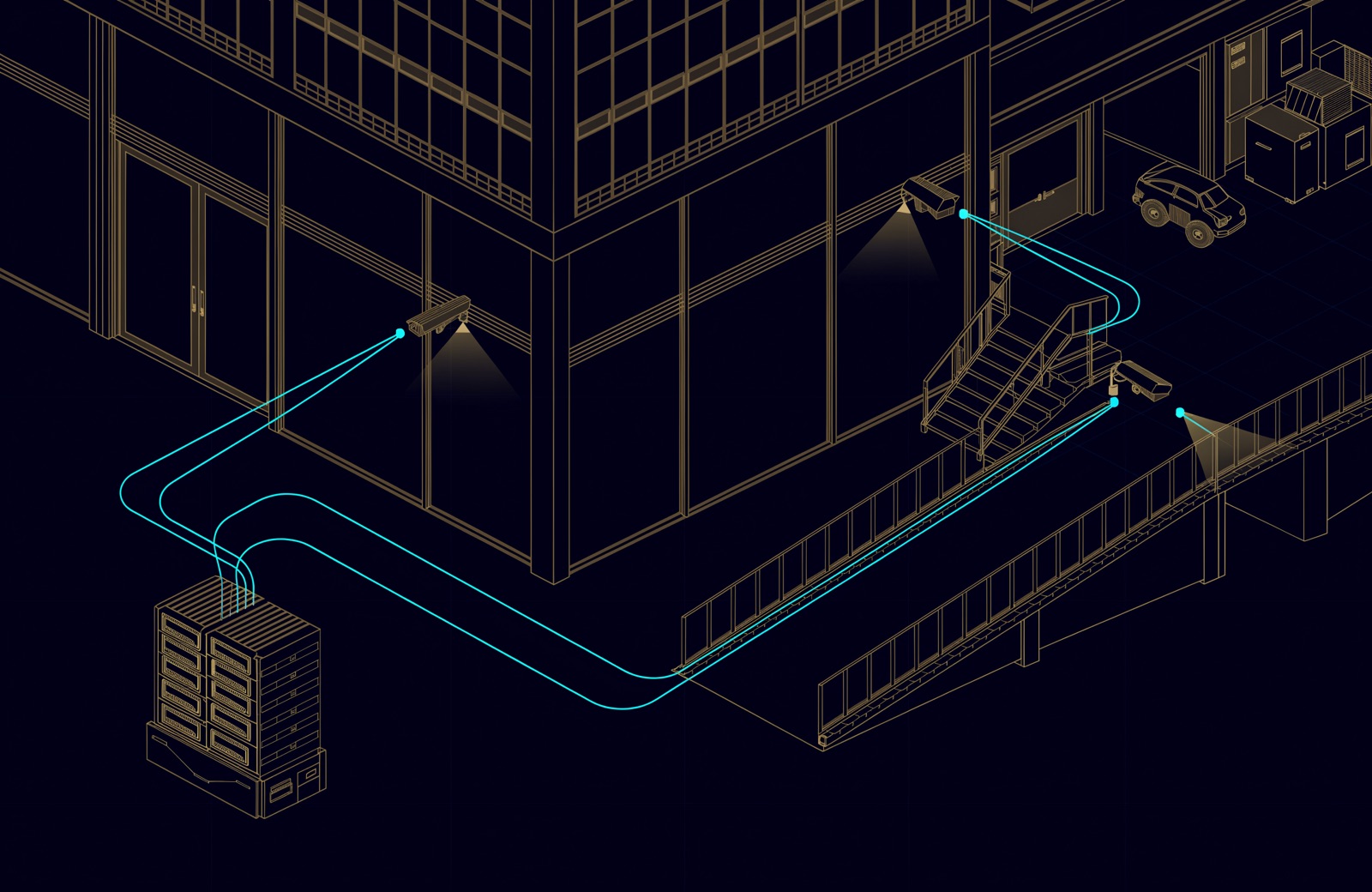
SIRA's CCTV requirements for Dubai are set by its 2025 Preventive Systems Manual. Cameras must be colour, at least 1080p, visible and IP66 outdoors. Recorders must record at 1080p, show live view at 25 fps and keep footage at least 31 days at 10 fps or more; some facility types need 60, 75 or 90 days.
The manual was approved by SIRA's Administrative Resolution No. 13 of 2025 and also covers recorders, cabling, the network, power, maintenance and 43 chapters of requirements by facility and activity. This guide follows the texts as published in October 2026. The English version is SIRA's translation; the Arabic text in the Official Gazette prevails.
Which law sets the SIRA CCTV regulations in Dubai?
Law No. 12 of 2016 regulates Dubai's security industry and makes the Security Industry Regulatory Agency (SIRA) responsible, among other duties, for ensuring that vital sectors, major compounds and public events have preventive systems: the precautionary measures, electronic systems and security equipment that protect establishments and people. Two instruments sit under it.
- The manual. Administrative Resolution No. 13 of 2025 was issued on 14 April 2025 and published in the Official Gazette, issue 721, on 30 May 2025, in force from publication. It applies to the establishments specified in the 2018 implementing bylaw and repeals any provision of another resolution or manual that contradicts it (Articles 2 to 4).
- The bylaw. Resolution No. 1 of 2026, published in Arabic on 4 July 2026 (issue 783), replaces the 2018 bylaw and keeps instruments issued under it in force, where they do not conflict, until replaced (Article 31). Article 19 requires security service providers and users, and the owners of the important complexes and vital sectors that SIRA specifies, to follow the manual.
SIRA's website still hosts the Preventative Systems Manual version 3.1 of January 2020, which also covered analogue systems. Its provisions are repealed wherever they contradict the 2025 manual, so write specifications against the 2025 text.
The law's examples of vital sectors are banks, money exchanges, gold and jewellery shops, hotels, shopping malls and hospitals; major compounds are residential or office buildings, towers and villa compounds. The facility chapters refer to an annex of covered commercial activities that is not in the published text, so ask SIRA which chapter matches your trade licence. Shared spaces in a multi-activity facility take the highest requirement among its activities (Part Two, Chapter 9).
One newer document matters too. In September 2026, Abu Dhabi's Monitoring and Control Centre published the National Manual for Surveillance Systems, version 3.0, whose cover lists SIRA among its concerned authorities. SIRA's certification service pages, read in October 2026, still point to the 2025 manual for the requirements, so confirm with SIRA which document your site will be audited against.
SIRA CCTV requirements for cameras
Part One, Chapter 1 sets twelve camera minimums. Together they describe a visible, day-and-night IP camera built to run without interruption.
| Requirement | Minimum in the 2025 manual | Item (Part One, Ch. 1, cameras) |
|---|---|---|
| Colour | Colour cameras | 1 |
| Resolution | 1080p Full HD or higher | 2 |
| Bit rate | Variable bit rate, no fixed rate and no maximum cap | 3 |
| Signal-to-noise ratio (dB) | 48 or more | 5 |
| Placement | Clearly visible, not hidden | 6 |
| Outdoor protection | IP66 or better, camera or housing | 8 |
| Wide dynamic range, WDR (dB) | 110 or equivalent, for any camera facing natural or artificial light, direct or reflected | 9 |
| Night | Infrared cut filter (IR-cut), switching automatically to monochrome night imaging when visible light fades | 11 |
| Mounted at 4 m or higher | Remote zoom and focus | 12 |
The remaining items require compatibility with standard management software, continuous-duty design and auto iris where light changes. Part Two adds two rules: identification cameras need 110 dB WDR wherever they are installed, and devices mounted below 2.5 m, within a person's reach, must be tamper-proof and vandal-proof with impact resistance of at least IK10 (Chapters 1 and 6). On item 11, the English text asks for infrared light; the Arabic, which prevails, asks for an infrared cut filter that switches automatically to monochrome at night.
Recording and frame rate: what the recorder must do
The recorder carries most of the numbers. Live view and recording have different frame rates: at least 25 frames per second per camera when watching, and at least 10 when recording.
| Requirement | Minimum in the 2025 manual | Item (Part One, Ch. 1, recorders) |
|---|---|---|
| Recorder type | Digital recording devices only | A1 |
| Recording resolution | 1080p Full HD | A2 |
| Live view resolution | 1080p for one camera; 2CIF per camera on a multi-camera screen | A3 |
| Live view frame rate (fps) | 25 per camera | A5 |
| Recording frame rate (fps) | 10 per camera, at high quality | C |
| Motion-activated recording | Set for at least 70% of the day per camera, at 10 fps or more | A10 |
| Retention (days) | 31 or more | A10, C |
| Spare capacity (%) | 20 on top of the calculated storage | A11 |
| Export | Standard format playable on Windows, copied in no more than a tenth of its playing time | A6, A7, A28 |
| Power (minutes) | All recorders on UPS; security systems run at least 30 on UPS | Sixth, 1 and 2 |
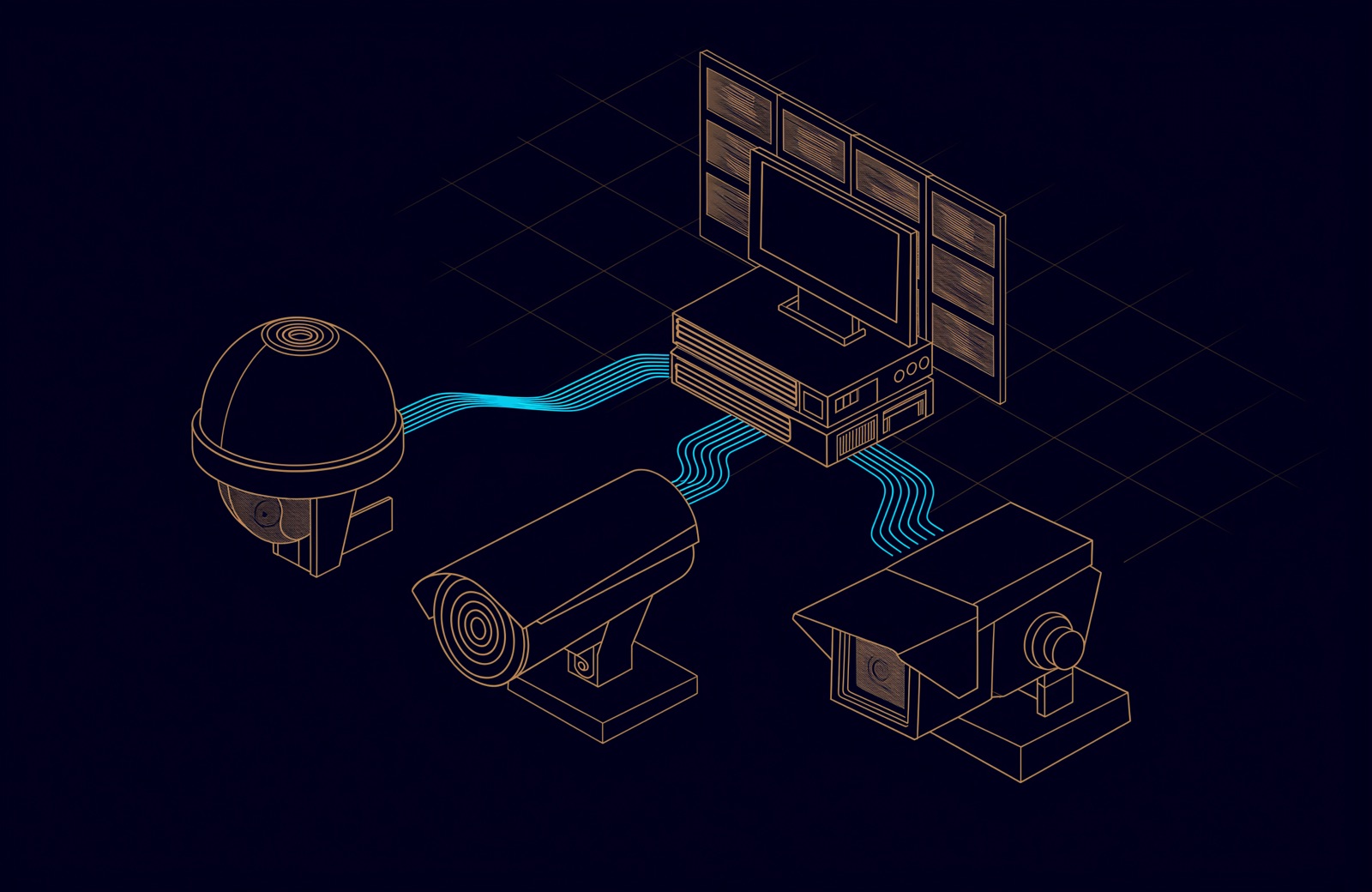
The recorder must also support ONVIF 2.0, RTSP and NTP, keep at least 10 seconds before and after an event, and raise alerts for disk failure, a full disk, camera failure and user logins. A video management system (VMS) is mandatory at 64 cameras or four recorders.
Because variable bit rate is mandatory and uncapped, size storage from averages measured on site, not from a datasheet. As an illustration only, a 1080p camera averaging 4 Mbit/s writes about 43 GB a day: 1.34 TB for 31 days, about 1.6 TB with the 20% margin, and about 3.9 TB for 90 days (4.7 TB with the margin).
Retention by facility: where 31 days is not enough
Thirty-one days is the floor, not the rule for every site. Several chapters in Part Three set longer periods or other recording rules for the cameras they name.
| Facility (manual chapter) | Minimum retention (days) | Other recording rule |
|---|---|---|
| All covered systems (Part One, Ch. 1) | 31 | At least 10 fps, high quality |
| Financial and monetary institutions (Part Three, Ch. 12, Second) | 31 for on-site cameras, 75 for ATM cameras | None |
| ATMs (Ch. 12, Fifth) | 75 for all cameras | None |
| Mobile ATMs (Ch. 12, Sixth) | Not set separately; the camera inside follows the ATM rules | Recording at least 1080p at 25 fps |
| Quran memorisation centres and Islamic institutions (Ch. 36) | 60 for all cameras | None |
| Self-storage and safe deposit rental (Ch. 20, Second) | 90 for all cameras | Camera system on backup power for 8 hours |
| Automated storage (Ch. 20, Third) | 90 for all cameras | Camera system on backup power for 8 hours |
| Jewellery and precious goods exhibitions (Ch. 11, Sixth) | Kept one month after the exhibition ends | None |
| Vehicles carrying hazardous materials (Ch. 41) | Not set separately | Recording at least 30 fps |
In our reading of the English and Arabic texts, these are the chapters that set a period other than 31 days; the rest rely on the baseline. Confirm your chapter with SIRA before sizing the recorder: a storage shortfall found at the audit is fixed with new disks, not a setting. Against the 31-day baseline, 60 days needs about 1.9 times the disk, 75 days about 2.4 times and 90 days about 2.9 times.
Network, cabling and power rules
The manual treats the camera network as part of the security system, not shared IT. It requires:
- A separate, dedicated private network for security systems only, with redundancy and a backup line for the backbone.
- A network management system (NMS) to monitor the network, identify outages and report them automatically, a clause the manual words for networks of more than 200 connected devices; above 200 devices, splitting the network into segments and clusters must also be considered, to avoid one large flat network.
- Support for both IPv4 and IPv6, and 20% spare network capacity.
- Twisted pair of at least Cat 6 in high-quality copper; copper-clad aluminium and copper-clad iron cables are not allowed.
- No wireless links unless SIRA approves them, and no connection to an outside network except for integration, behind a firewall and with SIRA's prior written approval.
- Every connection numbered and labelled at both ends, cables hidden in containment, tamper-proof power outlets, and drawings that match what is installed.
For how a dedicated camera network behaves under load, see when CCTV becomes a network problem; for the switches, see the PoE power budget guide.
Field of view: what each camera position must show
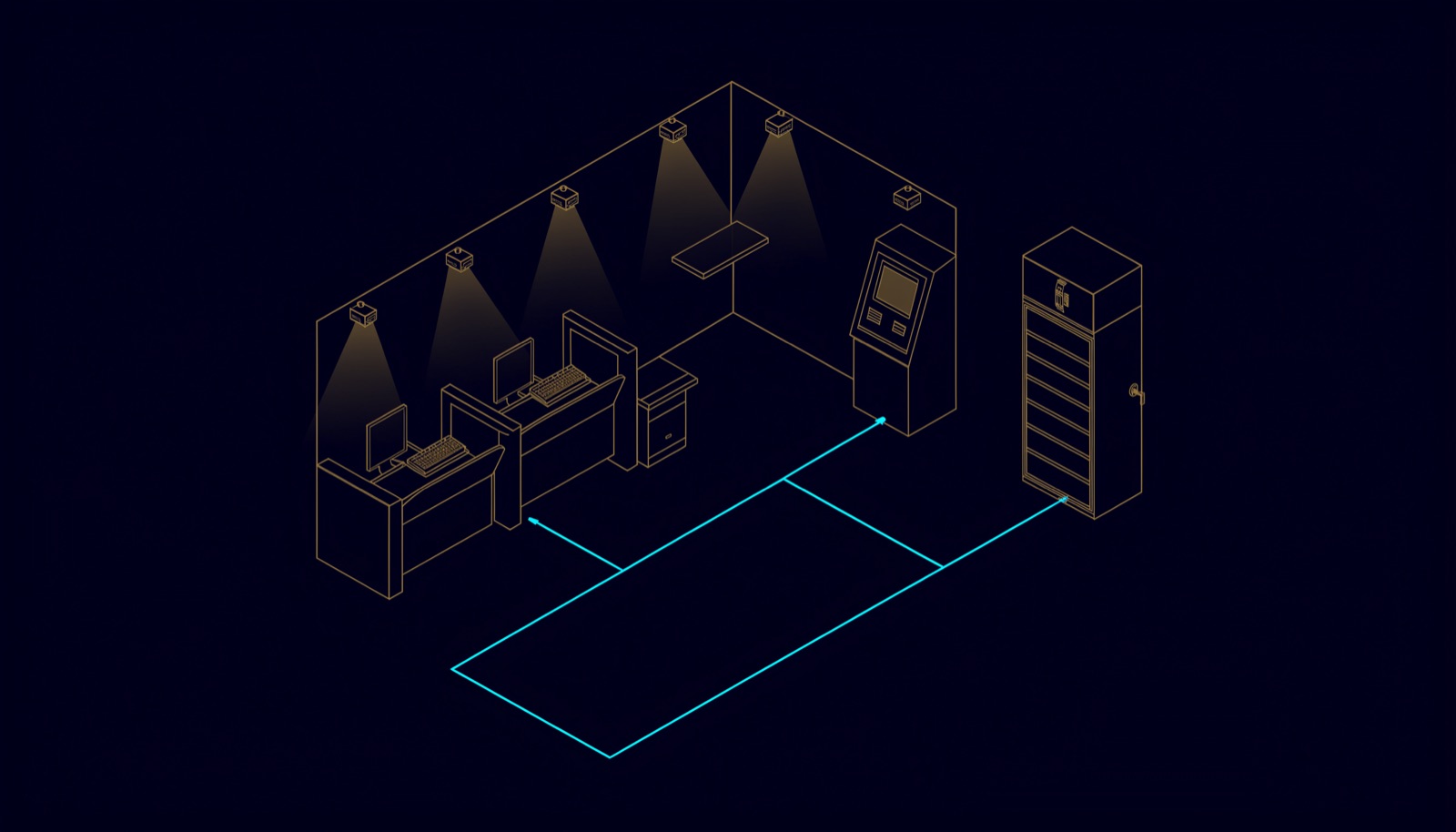
Each facility chapter assigns a view to each area, such as identification at entrances and recognition at cashier desks. Part Two, Chapter 1 defines each view by how much of the screen a standard target, a person 1.6 m tall, must fill; a pixel density may replace it only in exceptional cases, with SIRA's prior approval.
| View | Target size on screen (% of viewing area) | Alternative with SIRA approval (px/m) |
|---|---|---|
| Inspection | 400 | 1,000 |
| Identification | 120 | 300 |
| Recognition | 50 | 125 |
| Observation | 25 | 62.5 |
| Detection | 10 | 30 |
| Monitoring | 5 | 12.5 |
| Number plate read by eye (characters) | 20 | 400 |
The English text gives the observation figure per square metre; the Arabic, which prevails, says per metre. Each view also limits the mounting angle, and an image fails if obstructions cover more than 5% of it (Chapter 5). Lens choice is explained in our guide to CCTV systems for UAE businesses.
What SIRA prohibits, and what it asks of the site
Part Two, Chapter 8 prohibits three things unless SIRA approves them: cameras with pan and zoom capability in private areas, hidden cameras, and external roof cameras whose view extends beyond the facility's boundary. The facility must also provide:
- SIRA-approved warning signs at main entrances and inside lifts, an employee responsible for the systems, a record of every copy of footage, and synchronised time (Chapter 3).
- Recorders and network equipment in secure, restricted locations with an auditable entry log, and immediate notice to SIRA and the maintenance company of any incident that stops the systems (Chapter 6).
- A connection to a SIRA-approved system integrity monitoring service (Chapter 2).
- An annual maintenance contract with a SIRA-registered company, with at least four preventive visits a year, and notice to SIRA of any change, even a minor one, to the system or the site's layout or activity (Chapter 7).
SIRA CCTV approval: from security plan to certificate
SIRA's service pages describe two certificates and an audit, handled through its e-services portal. In practice the sequence runs:
- Security Plan Certificate (SPC). Submitted with the trade licence, a planning map and the project plan, and stamped by both the security consultancy company and the installation company.
- Installation by licensed companies and technicians. The 2026 bylaw prohibits providing a security service without a SIRA licence, and using an unlicensed provider (Article 2). Installing and maintaining security equipment, alarm and surveillance equipment included, is its own licence type (Article 3), and Article 10 sets an individual licence for security systems technicians. The manual requires every maintenance technician to be SIRA-licensed.
- Security audit. SIRA states that the activity must not start until a successful audit report is obtained.
- Security System Certification. Issued on the approved SPC and the audit report.
- Maintain and renew. Renewal needs an audit report valid for at least six months.
In October 2026, SIRA listed three business days for the SPC and two for certification, each at a service fee of AED 100 plus AED 10 knowledge and AED 10 innovation fees. Device models, cameras and recorders included, are approved separately through SIRA's Security Equipment and Devices Certification, applied for by a company whose trade licence includes installation and maintenance of security systems. Ask the installer for each quoted model's certificate.
How UBM handles it
UBM is an Abu Dhabi integrator. In Dubai, the regulated work, from the security plan to installation, maintenance and audit, runs through companies and technicians licensed by SIRA, so whoever you appoint, ask for the company's SIRA licence and its technicians' licences before you sign.
Where we help is the group view. We design and support IP CCTV estates, size recording for the retention a policy demands, and document camera positions and retention periods for audit. For a group with branches in Dubai, the SIRA minimums above make a sound floor for one internal CCTV policy: 1080p colour cameras with 110 dB WDR where they face light, recorders sized for the chapter's retention plus 20%, a dedicated network on UPS, and integration only behind a firewall with SIRA's prior written approval. At the Dubai sites, the design, installation and audit against that policy stay with the SIRA-licensed consultant, installer and auditor. Our scope is on the CCTV and physical security page; to have a CCTV policy or recorder sizing reviewed for your sites outside Dubai, talk to a UBM engineer.
Questions people ask
What are the minimum CCTV specifications required by SIRA in Dubai?
Colour IP cameras of at least 1080p, visible, IP66 outdoors and with 110 dB WDR where they face light. Recorders record at 1080p and at least 10 fps, show live view at 25 fps and keep 31 days of footage, with 20% spare storage.
How long must CCTV footage be kept in Dubai?
At least 31 days for the establishments the manual covers. Some chapters require more: 60 days for Quran memorisation centres and Islamic institutions, 75 days for ATM cameras and 90 days for self-storage and safe deposit rental.
Where is the SIRA CCTV regulations PDF?
SIRA publishes Administrative Resolution No. 13 of 2025 with the full manual in English on its website; the Arabic original is in the Dubai Official Gazette, issue 721. The 2020 manual, version 3.1, is still online, but its provisions are repealed wherever they contradict the 2025 text.
Who can install CCTV in Dubai?
A company holding a SIRA licence for installing and maintaining security equipment, using SIRA-licensed technicians. The bylaw also prohibits engaging an unlicensed provider, so the obligation falls on the client as well.
Does the SIRA manual apply in Abu Dhabi?
No, it is Dubai legislation. In Abu Dhabi, approval steps come from the Monitoring and Control Centre (MCC), which publishes the National Manual for Surveillance Systems. Version 3.0 of that manual (2026) names SIRA among its concerned authorities on its cover, so confirm with SIRA which document your Dubai site will be audited against.
Sources
- Administrative Resolution No. (13) of 2025 Approving the Preventive Systems Manual, English text with the manual (Security Industry Regulatory Agency, Dubai, 2025)
- Official Gazette of the Government of Dubai, issue 721, with the Arabic text of the Preventive Systems Manual (Supreme Legislation Committee, 30 May 2025; prevailing text)
- Administrative Resolution No. (13) of 2025, Arabic text as gazetted (Dubai Legislation Portal, 2025)
- Resolution No. (1) of 2026 Issuing the Implementing Bylaw of Law No. (12) of 2016 Regulating the Security Industry in the Emirate of Dubai (Dubai Legislation Portal, published 4 July 2026; Arabic)
- Law No. (12) of 2016 Regulating the Security Industry in the Emirate of Dubai (Dubai Legislation Portal, 2016)
- Preventative Systems Manual, version 3.1 (SIRA, January 2020; superseded: repealed wherever it contradicts the 2025 manual)
- Security Plans Certification, New Security System Certification, Renew Security System Certification and Security Equipment and Devices Certification service pages (SIRA, read October 2026)
- National Manual for Surveillance Systems, version 3.0 (Monitoring and Control Centre, Abu Dhabi, 2026; listed under Publications and Regulations on 22 September 2026)
Comments
Questions and experience from readers. A person reads every comment before it appears.
No comments yet. If something here does not match what you have seen on site, say so.